Home

Inspections

Radon Info

Septic Info

FAQ

Links

Contact Us

Top 2 Bottom Inspections Inc 919-631-1805

NC Contracting Lic. #47128 Home Inspector Lic. #1764 Septic Cert. #36351

Septic Systems

The purpose of a septic system is to retain solid waste in the tank and to dispose of effluent waste water into the ground without contaminating the environment.

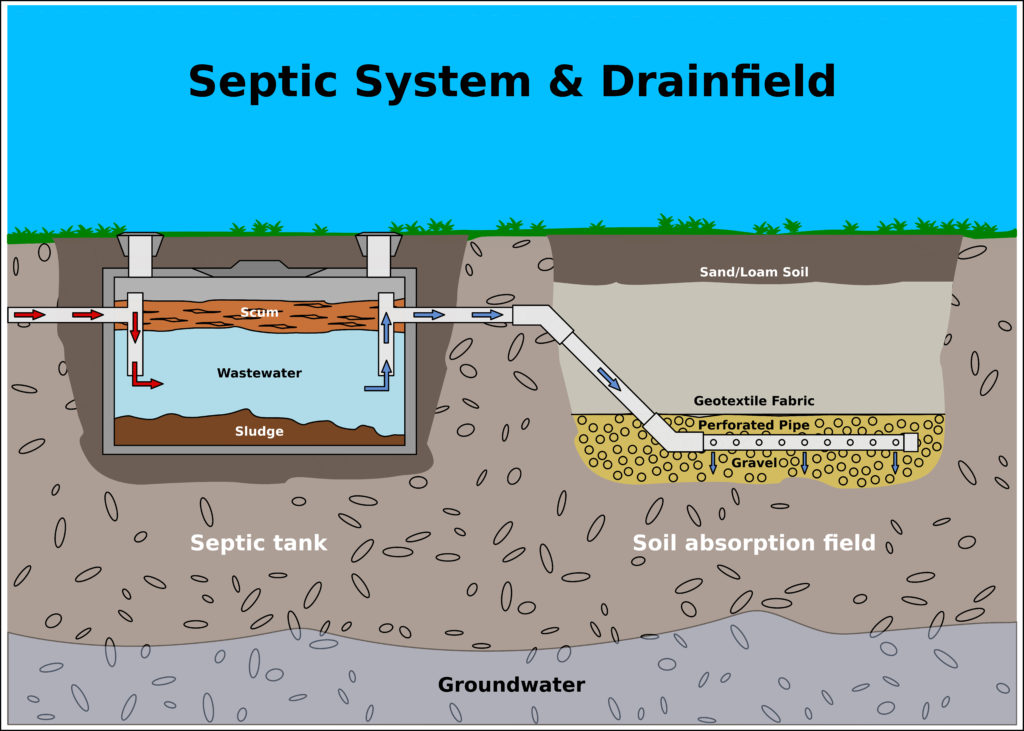
To accomplish this a septic system consists of the elements shown in the sketch above. In simplest terms, a septic system consists of a holding tank which retains solid waste and grease from household waste water, and an absorption system or "leach field" which disposes of liquid wastewater or "effluent" which leaves the septic tank for absorption below ground into soils at the property.


Let's just outline these main septic system parts in a little more detail:

The main waste line or "sewer line" connects the home's plumbing to the septic tank.

The septic tank which is often buried just a few feet from the house foundation wall, receives all waste (solid and liquid) and has the main job of retaining solids and grease. Solids settle to the bottom of the tank as sludge. A floating scum and grease layer forms at the top of the tank. Baffles at the tank inlet and outlet reduce the velocity of liquid moving through the tank and prevent solids and floating scum from leaving. Clarified effluent is allowed to flow out of the tank into a soil absorption system. In some states (Connecticut since January 1991) septic tanks now consist of two compartments in order to do a more effective job.

A effluent distribution pipe direct the flow of effluent from the septic tank to the leaching system, often connecting first to one or more distribution boxes which in turn distribute flow of effluent evenly into the leaching system.

A leaching system, or soil absorption system, also called "drainfield", a soakaway system, leachfield, or seepage bed disperses the sewage effluent into the surrounding natural soils. There are many types of leaching systems but the most common is a network of perforated pipes buried in gravel-filled trenches. The specific type utilized on a particular property depends on the soil conditions and the amount of space available.

Galleries or "septic galleys", seepage pits and sand beds have historically been used.

Most distribution piping and leaching systems are "gravity" systems, meaning the flow runs through piping and distribution boxes without the assistance of any mechanical device, such as a pump or siphon, but some homes pump their effluent uphill into a mound system.

Advanced wastewater treatment systems are also available to handle difficult sites.


Website powered by Network Solutions®