|
Radon is a naturally occurring, radioactive gas that can enter the buildings through holes and cracks in foundations. You can’t see, smell or taste it, but it’s the second leading cause of lung cancer in the U.S.
According to the Environmental Protection Agency (EPA), radon causes about 21, 000 fatal cases of lung cancer each year. Also, about 15 out of every 1,000 nonsmokers exposed to radon levels twice the EPA’s recommended action level will develop lung cancer.
This carcinogen is easily overlooked not only because it’s imperceptible, but because people are typically exposed to it where they feel safest – at home. The EPA estimates one in 15 homes in the U.S. has radon levels higher than tolerable. The U.S. Surgeon General recommends that all homes be tested for radon.
The good news? Radon problems are easy and relatively affordable for property owners to fix. In dealing with radon, awareness is key.
EPA Recommends
· Test your home for radon — it's easy and inexpensive.
· Fix your home if your radon level is 4 picocuries per liter, or pCi/L, or higher.
· Radon levels less than 4 pCi/L still pose a risk, and in many cases may be reduced.
Radon is a cancer-causing, radioactive gas.
You can't see radon. And you can't smell it or taste it. But it may be a problem in your home.
Radon is estimated to cause many thousands of deaths each year. That's because when you breathe air containing radon, you can get lung cancer. In fact, the Surgeon General has warned that radon is the second leading cause of lung cancer in the United States today. Only smoking causes more lung cancer deaths. If you smoke and your home has high radon levels, your risk of lung cancer is especially high.
Radon can be found all over the U.S.
Radon comes from the natural (radioactive) breakdown of uranium in soil, rock and water and gets into the air you breathe. Radon can be found all over the U.S. It can get into any type of building — homes, offices, and schools — and result in a high indoor radon level. But you and your family are most likely to get your greatest exposure at home, where you spend most of your time.
You should test for radon.
Testing is the only way to know if you and your family are at risk from radon. EPA and the Surgeon General recommend testing all homes below the third floor for radon.).
You can fix a radon problem.
Radon reduction systems work and they are not too costly. Some radon reduction systems can reduce radon levels in your home by up to 99%. Even very high levels can be reduced to acceptable levels.
New homes can be built with radon-resistant features.
Radon-resistant construction techniques can be effective in preventing radon entry. When installed properly and completely, these simple and inexpensive techniques can help reduce indoor radon levels in homes. In addition, installing them at the time of construction makes it easier and less expensive to reduce radon levels further if these passive techniques don't reduce radon levels to below 4 pCi/L. Every new home should be tested after occupancy, even if it was built radon-resistant. If radon levels are still in excess of 4 pCi/L, the passive system should be activated by having a qualified mitigator install a vent fan. For more explanation of radon resistant construction techniques, refer to EPA publication, Building Radon Out: A Step-by-Step Guide on How to Build Radon-Resistant Homes (see www.epa.gov/radon/rrnc).
How Does Radon Get Into Your Home?
Any home may have a radon problem
Radon is a radioactive gas. It comes from the natural decay of uranium that is found in nearly all soils. It typically moves up through the ground to the air above and into your home through cracks and other holes in the foundation. Your home traps radon inside, where it can build up. Any home may have a radon problem. This means new and old homes, well-sealed and drafty homes, and homes with or without basements.
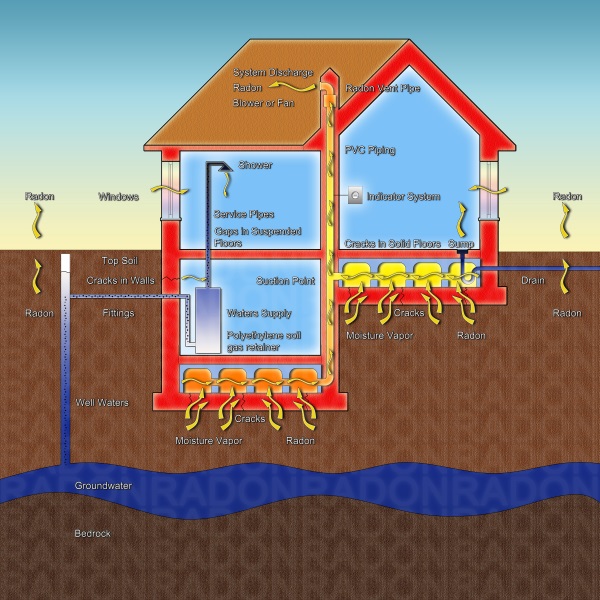
Radon from soil gas is the main cause of radon problems. In a small number of homes, the building materials can give off radon, too. However, building materials rarely cause radon problems by themselves.
|
RADON GETS IN THROUGH:
1. Cracks in solid floors
2. Construction joints
3. Cracks in walls
4. Gaps in suspended floors
5. Gaps around service pipes
6. Cavities inside walls
7. The water supply
|
|
Nearly 1 out of every 15 homes in the U.S. is estimated to have elevated radon levels. Elevated levels of radon gas have been found in homes in your state. While radon problems may be more common in some areas, any home may have a problem. The only way to know about your home is to test.
How to Test Your Home
You can't see radon, but it's not hard to find out if you have a radon problem in your home. All you need to do is test for radon. The amount of radon in the air is measured in "picocuries per liter of air," or "pCi/L."
There are Two General Ways to Test for Radon:
SHORT-TERM TESTING:
The quickest way to test is with short-term tests. Short-term tests remain in your home for two days to 90 days, depending on the device. "Charcoal canisters," "alpha track," "electret ion chamber," "continuous monitors," and "charcoal liquid scintillation" detectors are most commonly used for short-term testing. Because radon levels tend to vary from day to day and season to season, a short-term test is less likely than a long-term test to tell you your year-round average radon level. If you need results quickly, however, a short-term test followed by a second short-term test may be used to decide whether to fix your home.
How To Use a Test Kit:
Testing is easy and should only take a few minutes of your time.
Follow the instructions that come with your test kit. If you are doing a short-term test, close your windows and outside doors and keep them closed as much as possible during the test. Heating and air-conditioning system fans that re-circulate air may be operated. Do not operate fans or other machines which bring in air from outside. Fans that are part of a radon-reduction system or small exhaust fans operating only for short periods of time may run during the test. If you are doing a short-term test lasting just 2 or 3 days, be sure to close your windows and outside doors at least 12 hours before beginning the test, too. You should not conduct short-term tests lasting just 2 or 3 days during unusually severe storms or periods of unusually high winds. The test kit should be placed in the lowest lived-in level of the home (for example, the basement if it is frequently used, otherwise the first floor). It should be put in a room that is used regularly (like a living room, playroom, den or bedroom) but not your kitchen or bathroom. Place the kit at least 20 inches above the floor in a location where it won't be disturbed - away from drafts, high heat, high humidity, and exterior walls. Leave the kit in place for as long as the package says. Once you've finished the test, reseal the package and send it to the lab specified on the package right away for analysis. You should receive your test results within a few weeks.
LONG-TERM TESTING:
Long-term tests remain in your home for more than 90 days. "Alpha track" and "electret" detectors are commonly used for this type of testing. A long-term test will give you a reading that is more likely to tell you your home's year-round average radon level than a short-term test.
EPA Recommends the Following Testing Steps:
Step 1. Take a short-term test. If your result is 4 pCi/L or higher take a follow-up test (Step 2) to be sure.
Step 2. Follow up with either a long-term test or a second short-term test:
· For a better understanding of your year-round average radon level, take a long-term test.
· If you need results quickly, take a second short-term test.
The higher your initial short-term test result, the more certain you can be that you should take a short-term rather than a long-term follow up test. If your first short-term test result is more than twice EPA's 4 pCi/L action level, you should take a second short-term test immediately.
Step 3. If you followed up with a long-term test: Fix your home if your long-term test result is 4 pCi/L or more. If you followed up with a second short-term test: The higher your short-term results, the more certain you can be that you should fix your home. Consider fixing your home if the average of your first and second test is 4 pCi/L or higher.
What Your Test Results Mean
Test your home now and save your results. If you find high radon levels, fix your home before you decide to sell it.
The average indoor radon level is estimated to be about 1.3 pCi/L, and about 0.4 pCi/L of radon is normally found in the outside air. The U.S. Congress has set a long-term goal that indoor radon levels be no more than outdoor levels. While this goal is not yet technologically achievable in all cases, most homes today can be reduced to 2 pCi/L or below.
Sometimes short-term tests are less definitive about whether or not your home is above 4 pCi/L. This can happen when your results are close to 4 pCi/L. For example, if the average of your two short-term test results is 4.1 pCi/L, there is about a 50% chance that your year-round average is somewhat below 4 pCi/L. However, EPA believes that any radon exposure carries some risk - no level of radon is safe. Even radon levels below 4 pCi/L pose some risk, and you can reduce your risk of lung cancer by lowering your radon level.
If your living patterns change and you begin occupying a lower level of your home (such as a basement) you should retest your home on that level.
Even if your test result is below 4 pCi/L, you may want to test again sometime in the future.
Radon and Home Sales
More and more, home buyers and renters are asking about radon levels before they buy or rent a home. Because real estate sales happen quickly, there is often little time to deal with radon and other issues. The best thing to do is to test for radon NOW and save the results in case the buyer is interested in them. Fix a problem if it exists so it won't complicate your home sale.
During home sales:
· Buyers often ask if a home has been tested, and if elevated levels were reduced.
· Buyers frequently want tests made by someone who is not involved in the home sale.
· Buyers might want to know the radon levels in areas of the home (like a basement they plan to finish) that the seller might not otherwise test.
Today many homes are built to prevent radon from coming in. Your state or local area may require these radon-resistant construction features. If you are buying or renting a new home, ask the owner or builder if it has radon-resistant features. The EPA recommends building new homes with radon-resistant features in high radon potential (Zone 1) areas. Even if built radon-resistant, every new home should be tested for radon after occupancy.
|